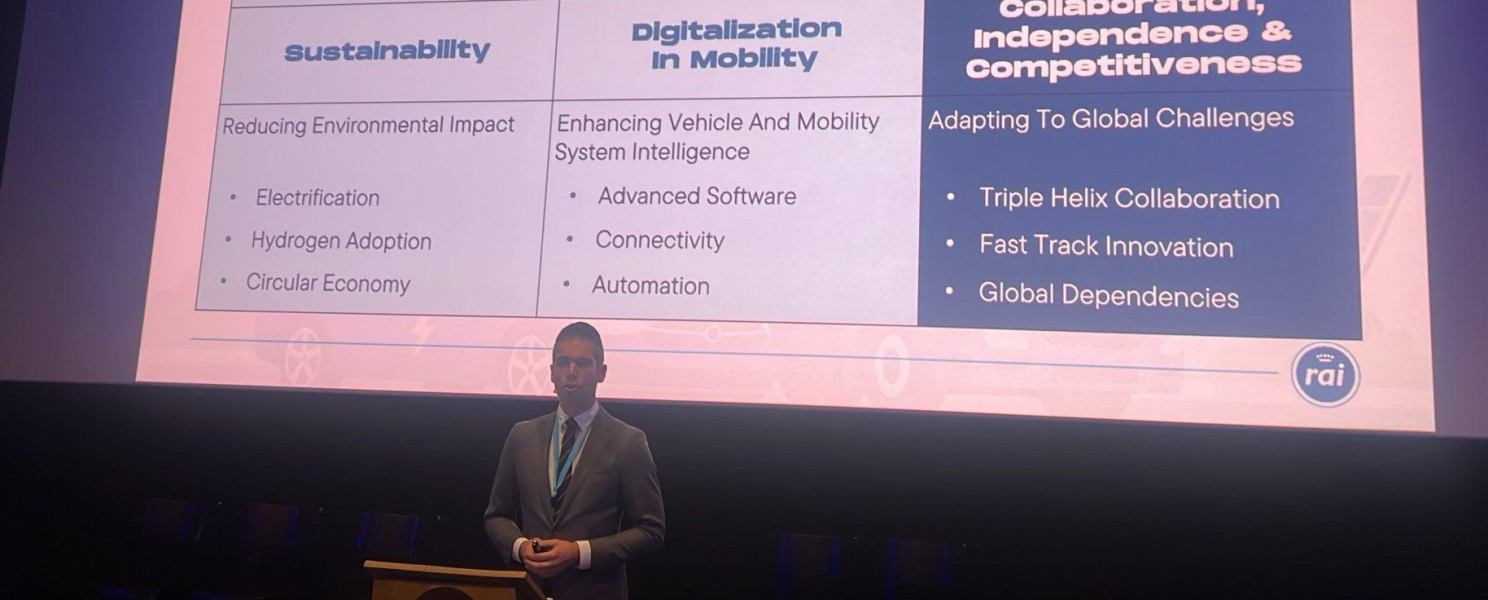
During the autoMEETive event, where the Automotive Roadmap 2025–2035 was referenced, one message stood out clearly: the coming decade will determine the competitive position of both the Dutch and the European automotive industry. The roadmap illustrates how the Netherlands can strengthen its position in this complex and rapidly changing landscape. Its content highlights how essential it is to focus firmly on the pillars of sustainability and digitalisation, which form the foundation of future mobility.
As Jeroen van den Oetelaar, Board of Management at DAF Trucks, aptly stated: “To lead is to look ahead.”
The roadmap provides exactly that — a strategic compass for a sector in the midst of radical transformation.
A Sector Under Pressure: Economic and Societal Forces at Work
The numbers are clear. The Dutch mobility sector generates roughly €50 billion in annual revenue, with 13% invested in R&D — an exceptionally high innovation intensity. Yet at the same time, the pressure on the industry is mounting:
European climate regulations are strict, and the cost of non-compliance is high. Jeroen shared a striking example: missing CO₂ targets could cost €150 million per percentage point.
Dependency on critical materials, semiconductors, and energy sources is becoming a geopolitical vulnerability.
Europe faces a growing shortage of truck drivers, expected to reach 745,000 vacancies by 2028.
The energy transition demands rapid expansion of charging infrastructure, hydrogen development and smart energy hubs.
The roadmap addresses these challenges holistically — combining technology, economics, policy and collaboration across the entire mobility ecosystem.
Four Strategic Themes Shaping the Road Ahead
The roadmap zooms in on 4 key areas that will shape mobility between now and 2035.
1. Sustainability & Energy Transition
Electrification is accelerating, but diversification is key.
Battery innovation is shifting toward higher energy density, solid-state concepts, and promising alternatives such as sodium-ion to reduce dependency on critical materials.
Hydrogen will play a structural role — both in fuel cell systems and in the promising H2-ICE engine concept for long-haul heavy-duty freight.
Internal combustion engines remain relevant through smart efficiency improvements, hybridisation and renewable fuels such as eFuels and HVO100.
Circularity is evolving from sustainability to geopolitical necessity, ensuring access to critical raw materials through recycling and closed-loop supply chains.
2. Digitalisation & Software-Defined Vehicles
The vehicle becomes a digital ecosystem.
Software-Defined Vehicles (SDVs) replace traditional E/E architectures with centralised computing platforms.
AI enables vehicles to learn, predict and adapt — from driver monitoring to personalised interfaces and predictive maintenance.
5G/6G, V2X and connected infrastructures turn mobility into a “system of systems,” enabling real-time interaction between vehicles, infrastructure and users.
Cybersecurity becomes a fundamental requirement for safety and trust.
3. Automation & Autonomous Mobility
Autonomous mobility shifts from vision to necessity.
Europe’s driver shortage fuels the need for high-level automation in logistics.
The Netherlands expects four autonomous driving pilots, including one specifically for heavy-duty transport.
Autonomous and remotely supervised driving technologies are advancing rapidly, building on ADAS and cooperative mobility systems.
Automation offers cleaner, more efficient, more accessible mobility — especially in urban areas.
4. Circularity, Materials & Smart Manufacturing
The factory of the future is adaptive, data-driven and sustainable.
AI-based production, digital twins and additive manufacturing redefine efficiency and flexibility.
New materials — lightweight, bio-based and recycled — help reduce emissions and resource dependency.
Manufacturing systems must support modular, zero-defect and fast-switching production for both small series and large volumes.
Supply chains must become more resilient and less dependent on single-source global suppliers.
Collaboration as the Only Path Forward
Throughout the session, one message grew steadily louder: the future of the automotive sector depends on collective action. As Jeroen van den Oetelaar emphasised, “There is simply no investment power to do this alone. We have to collaborate — and we need a strong knowledge base to support that.” His remark set de tone for a conversation in which cooperation proved to be the key ingredient for success.From the perspective of innovation funding, Frank Toebes, Ceo of NRF, highlighted how essential a shared storyline has become: “Everything we are developing — whether in Poland or Granada — is partly subsidised. That requires a lobby, and a lobby needs a story. This Roadmap finally gives us that story.” His words underlined how the roadmap not only directs technology, but also strengthens the political and financial foundation beneath it.
The economic dimension was brought into focus by Pim Grol, Managing Director of RAI Automotive Industry NL, who stressed the need to link innovation to market reality: “We must think in business cases. It’s the only way to get things moving — and to make that happen, the Dutch government has to be at the table as well.” The transition demands not only technological solutions, but also viable models that support scaling.
Finally, the urgency of the moment was captured by Martijn Stamm, Director Mobility at TNO, who spoke about the broader industrial context: “We are at a pivotal point for industry policy and investments. We expect four autonomous driving pilots to be financed — one focused on heavy-duty transport — because we need them to stay competitive and reduce congestion.” His reflection showed that the decisions taken now will influence Europe’s competitive position for years to come.
Together, these voices paint a clear picture: the Automotive Roadmap 2025–2035 is more than a document. It is a unified call to action — a commitment grounded in shared vision, economic realism and the understanding that collaboration is the only way forward.
Conclusion: A Clear Direction and a Shared Responsibility
The Automotive Roadmap 2025–2035 provides a clear direction for a future in which mobility is cleaner, smarter and more resilient. But its strength lies not in the document itself — it lies in our ability to act on it together. The transition ahead is too complex for individual organisations to navigate alone. Success will depend on the willingness of industry, government, knowledge institutions and emerging innovators to work as one ecosystem.
Sascha Bloemhoff, Managing Director of Automotive Campus conlude: "For the campus, this means continuing to invest in the knowledge base, strengthening cross-sector partnerships and supporting companies as they shift toward sustainable and digital mobility solutions. At the same time, people remain central to the transformation. Equipping professionals with the skills, mindset and adaptability required for a rapidly changing industry is just as important as the technologies we develop. The roadmap sets the ambition and outlines the path. Now it is up to all of us to bring it to life. The future of mobility will be built through collaboration, commitment and shared leadership — and that work starts today".