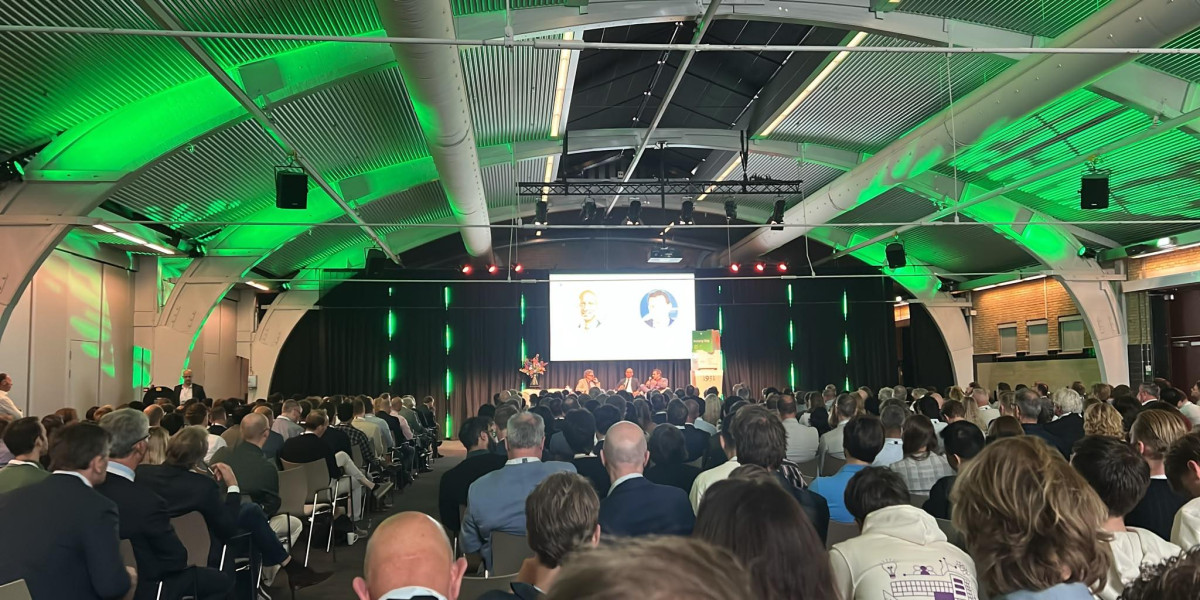
Battery Day highlights Europe's next challenge: scaling Europe's battery ecosystem
How can Europe remain competitive in one of the world's fastest-growing strategic industries? That question was central during Battery Day, where industry leaders, researchers, policymakers and innovators came together to discuss the future of Europe's battery ecosystem. One of the highlights of the day was the launch of the renewed Dutch National Battery Strategy, outlining a coordinated approach to strengthen the Netherlands' position within the European battery value chain.
While battery technology itself continues to advance rapidly, the discussions made clear that innovation alone will not determine Europe's future competitiveness. The real challenge lies in translating technological breakthroughs into scalable industrial solutions.
From innovation to industrialisation
Professor Dr. Simon Lux, Director of the Fraunhofer Research Institution for Battery Cell Production, emphasised that Europe already has world-class scientists and highly innovative companies. The challenge is ensuring that promising technologies successfully make the transition from research to industrial application.
Rather than starting innovation from the laboratory, new developments increasingly need to begin with real-world challenges. Scaling battery technologies requires much more than a single breakthrough. Every innovation must fit within the wider battery ecosystem, from production methods and supply chains to recycling and system integration.
One important step in bridging this gap is the development of pilot factories, where technologies can be validated before moving towards large-scale manufacturing.
Europe's strength lies in system integration
According to TNO CEO Tjark Tjin-A-Tsoi, Europe should not try to compete directly with Asia on battery production volumes. Instead, Europe should build on one of its greatest strengths: system integration. Battery technology is becoming increasingly interconnected with energy systems, charging infrastructure, software and digital services. Developing these systems together offers opportunities for Europe to strengthen its competitive position while reducing strategic dependencies.
Several speakers also highlighted the growing importance of battery infrastructure as critical infrastructure, making strategic autonomy increasingly important.
Building resilience through the battery value chain
Current dependencies remain significant. During the event it was highlighted that Europe is heavily dependent on China for several critical battery components. This underlines the importance of strengthening European production capacity, developing circular value chains and focusing on those parts of the battery ecosystem where Europe can create distinctive value.
For the Netherlands, opportunities were identified particularly in upstream technologies such as advanced anodes, thin-film technologies and innovative production methods.
At the same time, scale remains essential. As several speakers noted, moving from successful prototypes towards large-scale manufacturing requires both investment and early market demand. Lessons from the automotive industry demonstrate that industrialisation is just as important as innovation itself.
Dutch scale-ups demonstrate the next generation of battery innovation
The afternoon featured presentations from several Dutch battery scale-ups, each demonstrating different approaches to strengthening Europe's battery ecosystem. Companies including LeydenJar, LionVolt and Ore Energy presented innovations ranging from advanced anode technologies and high-density battery cells to long-duration energy storage solutions. Although their technologies differ, they all face similar challenges: accelerating time-to-market, securing investment and scaling production within Europe.
Their stories illustrated that the Netherlands possesses considerable technological expertise, but that continued collaboration across industry, research and government will be essential to successfully commercialise these innovations.
Launch of the renewed National Battery Strategy
An important milestone during Battery Day was the presentation of the renewed Dutch National Battery Strategy. Building on the original Action Agenda published in 2022, the updated strategy shifts the focus from a call to action towards a call to accelerate. The strategy is built around five pillars:
- Resilience
- Sustainability and circularity
- Safety
- Economic opportunities
- Applications for societal challenges
Developed through collaboration between multiple ministries and the wider battery ecosystem, the strategy provides a shared framework for strengthening the Netherlands' role within the European battery value chain.
What does this mean for Automotive Campus?
Many of the themes discussed during Battery Day closely align with the ambitions of Automotive Campus. Developing future battery technologies requires more than scientific excellence. It requires environments where technologies can be developed, tested, validated and demonstrated in collaboration with industry, research organisations and public authorities. As Europe's mobility and energy systems become increasingly interconnected, collaboration across disciplines will become even more important.
By bringing together companies, startups, researchers, educational institutions and governments within one innovation ecosystem, Automotive Campus contributes to accelerating the journey from research towards real-world implementation.
The discussions during Battery Day confirmed that Europe's battery future will not be determined by individual technologies alone. Success will depend on collaboration, system integration and the ability to scale innovation into industrial reality.