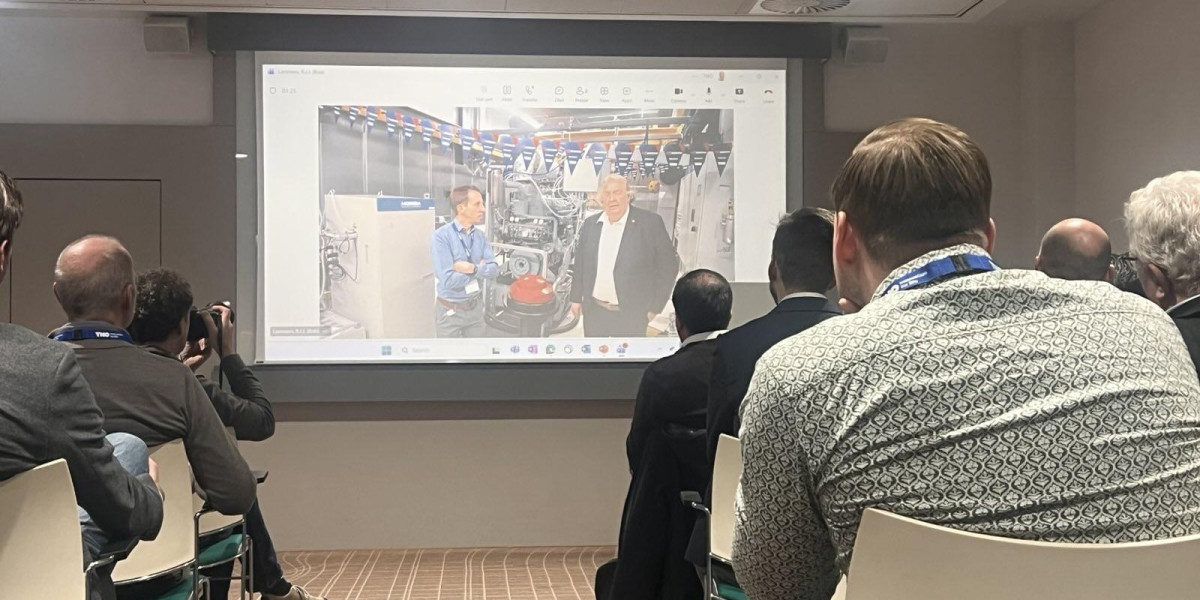
Yesterday, TNO officially opened the renewed Cell Technology Center within its Powertrain Center. With this expansion, TNO takes an important step in accelerating the transition to sustainable mobility – not only for the automotive sector, but now also for the maritime domain.
The new maritime test cell is a high-power engine test facility designed specifically for the needs of the maritime sector. Combined with a new hydrogen fuel park capable of supplying high-pressure hydrogen for up to three tube trailers, and a fully equipped H2 test cell for power levels up to 700 kW on both hydrogen and methanol, TNO now offers capabilities that are unique in Europe and, in some cases, worldwide.
These expanded facilities enable the full innovation chain: from early-stage concepts and prototype engines all the way to scaling up for real-world application. With this, TNO reinforces its commitment to working with partners on practical, scalable solutions to decarbonize mobility.
Industry perspective: the inland shipping pathway to 2050
During the opening, Khalid Tachi, Director of the Expertise and Innovation Centre Inland Waterway Transport (EICB), shared insights into the challenges and opportunities for the inland shipping sector. According to Tachi, the transition pathway to 2050 will consist of a combination of combustion and electrification, with alternative fuels playing a crucial role.
Early frontrunners in inland shipping are already demonstrating that hydrogen and electrification are feasible today. Promising energy carriers include green methanol, hydrogen, green LNG and electricity. However, the shift away from diesel remains challenging: the Total Cost of Ownership (TCO) of alternative fuels is still significantly higher.
Tachi emphasized that subsidizing only the initial investment will not be enough. To meet climate targets, additional measures will be required to make diesel less attractive.
Accelerating sustainable solutions together
With its expanded Powertrains Test Centre, TNO is fully prepared to support industry partners in the development, testing and scaling of sustainable powertrain solutions—helping accelerate the transition to cleaner mobility on both road and water.