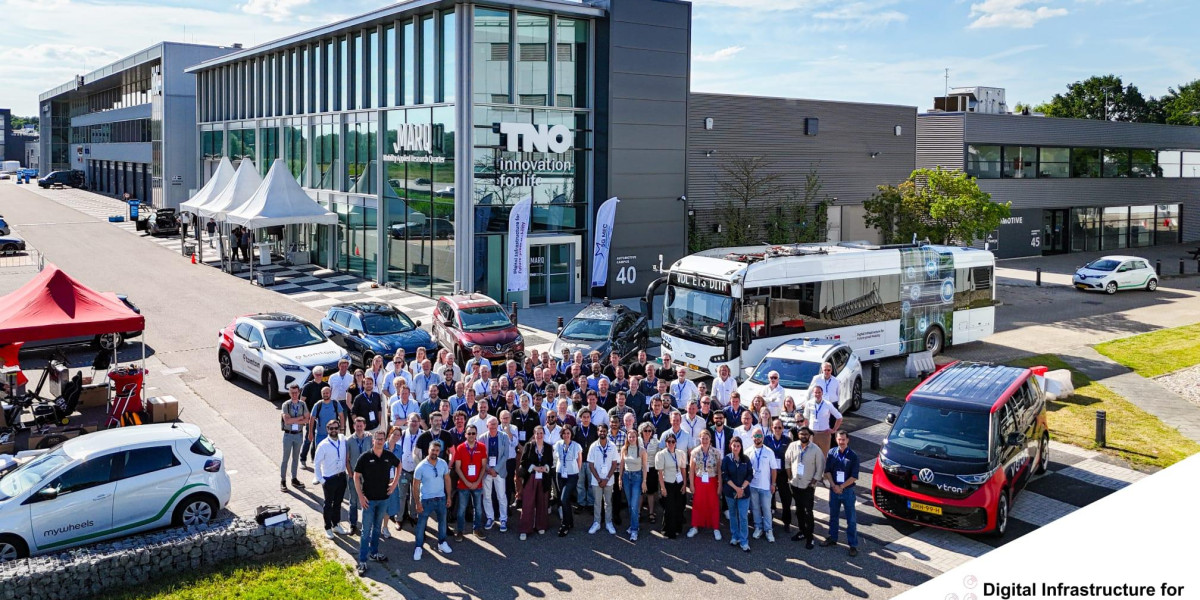
One message echoed throughout the DITM Final Event at Automotive Campus: Future mobility is a systems challenge. Over the past four years, DITM (Digital Infrastructure for Future Mobility) has brought together partners from industry, government and research to develop the digital foundations needed for connected, automated and sustainable mobility. The project reflects exactly what we stand for: open collaboration and co-creation between partners working towards a shared goal.
A key insight from the project is that vehicle systems, digital maps, traffic management, cloud infrastructure and energy systems are becoming increasingly interconnected. They can no longer be developed in isolation. They need to work together seamlessly. As Naomi Verstraeten (Brainport Development) highlighted, the original vision behind DITM was the Brainport Line. The next challenge is deployment: translating innovation into real-world implementation and scaling successful concepts towards operational mobility solutions. That requires system integration and interoperability.
Martijn Stamm (TNO) pointed out that one of the unique strengths of DITM has been its integrated approach and the close collaboration between public and private partners. Bringing different perspectives together has helped accelerate innovation and create solutions that extend beyond individual organisations.
Several industry leaders highlighted what comes next. Paul Hesen (TomTom) emphasised the importance of strengthening Europe’s position in digital vehicle systems through collaboration across the ecosystem, creating value for industry and society alike. Mark Smidts (Siemens) underlined the growing importance of cybersecurity as a foundation for future digital and charging infrastructure. And Glenn Haverkort (VDL ETS) stressed the need for viable business models that can make autonomous, efficient and safe mobility economically sustainable at scale. The discussions also highlighted the strong connection between DITM and initiatives such as 5G MEC. Together, they help bridge the gap between research and deployment by ensuring that future mobility requirements are already considered in today’s data and cloud infrastructure.
DITM may be coming to an end, but the need for collaboration around digital infrastructure is only increasing. Because the future of mobility will not be built by individual technologies. It will be built by connected systems working together.